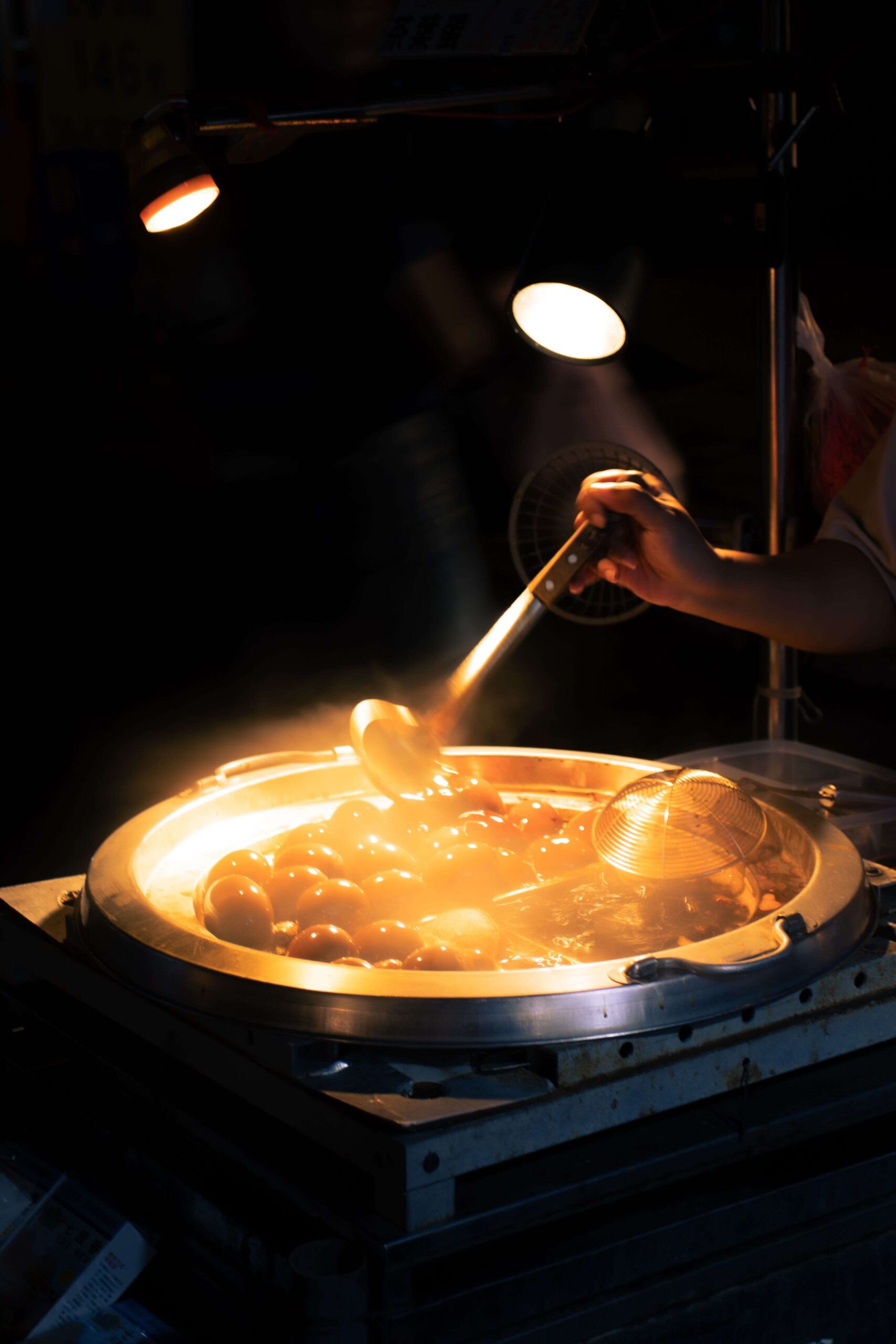
If you’ve watched a Korean drama, explored Seoul after dark or spent any time learning about Korean drinking culture, you’ve probably come across the word pocha.
But what is a Korean pocha, exactly?
At its simplest, a pocha is a casual place where people gather over food and drinks. The term comes from pojangmacha (포장마차) — the covered street stalls traditionally associated with late-night food, soju and small groups sitting close together around simple tables.
Today, however, not every pocha is literally a tent on the street.
Modern indoor bars and restaurants can also use the pocha concept, recreating the casual food, drinks and social atmosphere of traditional pojangmacha.
In this guide, we’ll explain pocha meaning, the difference between pocha and pojangmacha, what you’ll find on a typical pocha menu, what Koreans drink there, basic etiquette and where first-time visitors can experience pocha culture in Seoul.
What Is a Korean Pocha?
Pocha (포차) is the shortened everyday form of pojangmacha (포장마차), a type of casual Korean food-and-drink venue traditionally associated with covered street stalls.
Traditional pojangmacha often appear in the evening, serving simple food alongside drinks such as soju and beer.
Today, the word pocha is used more broadly and can also describe indoor bars or restaurants inspired by the same relaxed, late-night atmosphere.
Think:
—not simply “a Korean bar.”
Official Korean tourism sources still describe pojangmacha as street food stalls closely associated with snacks, alcohol and nighttime socializing.
Source: VISITKOREA
Table of contents
01 What Is a Korean Pocha?
02 Pocha Meaning & Pocha vs Pojangmacha
03 What Is a Korean Pocha Actually Like?
04 What Do You Eat at a Korean Pocha?
05 What Do Koreans Drink at a Pocha?
06 What Is Anju at a Pocha?
07 Korean Pocha Etiquette
08 Do You Have to Drink Alcohol?
09 Is a Korean Pocha Expensive?
10 Where to Experience a Pocha in Seoul
11 Why Pochas Appear in K-Dramas
12 K-Drama Pocha Locations in Seoul
13 Common Pocha Mistakes
14 Korean Pocha FAQ
15 Final Thoughts
What Does Pocha Mean in Korean?
The word pocha (포차) is a shortened form of:
포장마차pojangmacha · full term→포차pocha · everyday
In everyday conversation, people often shorten the full word and simply say pocha.
That distinction becomes useful because the meaning has also broadened over time.
A traditional pojangmacha usually brings to mind a small street stall, cart or tent that comes alive in the evening.
A modern pocha may be indoors, larger and more polished while still borrowing the same casual formula:
food to share, drinks on the table and a relaxed social atmosphere.
So if someone says:
“Let’s go to a pocha.”
don’t automatically picture a literal orange tent on a Seoul sidewalk.
It might be one.
But it might also be an indoor restaurant styled around pocha culture.
Pocha vs Pojangmacha: What's the Difference?
The terms are closely related, but they are not always used in exactly the same way today.
| Pocha 포차 | Pojangmacha 포장마차 | |
|---|---|---|
| Term | Shortened everyday form | Full Korean term |
| Traditional image | Broad pocha-style venue | Covered street stall or tent |
| Indoor versions | Very common today | Traditionally associated with outdoor stalls |
| Food | Shared casual dishes and anju | Street food and drinking food |
| Drinks | Often soju, beer and other drinks | Commonly soju and beer at evening stalls |
| Atmosphere | Casual and social | Casual, compact and street-oriented |
The easiest way to remember it is:
Pojangmacha is the traditional full term. Pocha is the shorter term that is now used more broadly.
This is why you’ll see both a row of vinyl-covered street stalls in Jongno and modern indoor establishments described as pocha.
Official Korean tourism listings continue to describe pojangmacha as street-food carts that serve snacks and alcohol, while modern restaurants can openly use the pojangmacha/pocha concept indoors.
Source: VISITKOREA
What Is a Korean Pocha Actually Like?
There isn’t one universal pocha experience.
And that’s part of the appeal.
Traditional street-style pocha
A traditional street-style pocha might have: small tables, plastic stools, vinyl walls, steam from cooking pots and only a relatively compact menu.
Modern indoor pocha
A modern indoor pocha may have neon signs, loud music, larger tables and dozens of dishes.
But the general idea is similar.
You’re not usually going there for silent fine dining.
You’re going to:
eat, drink, talk and spend time around the table.
Pocha culture is closely connected to the social side of Korean nightlife.
And in areas such as Jongno 3-ga, the street itself becomes part of the experience once the stalls appear after sunset. Official Visit Seoul material describes the area as a lively evening social hub filled with tents, food and drinks.
Source: Visit Seoul
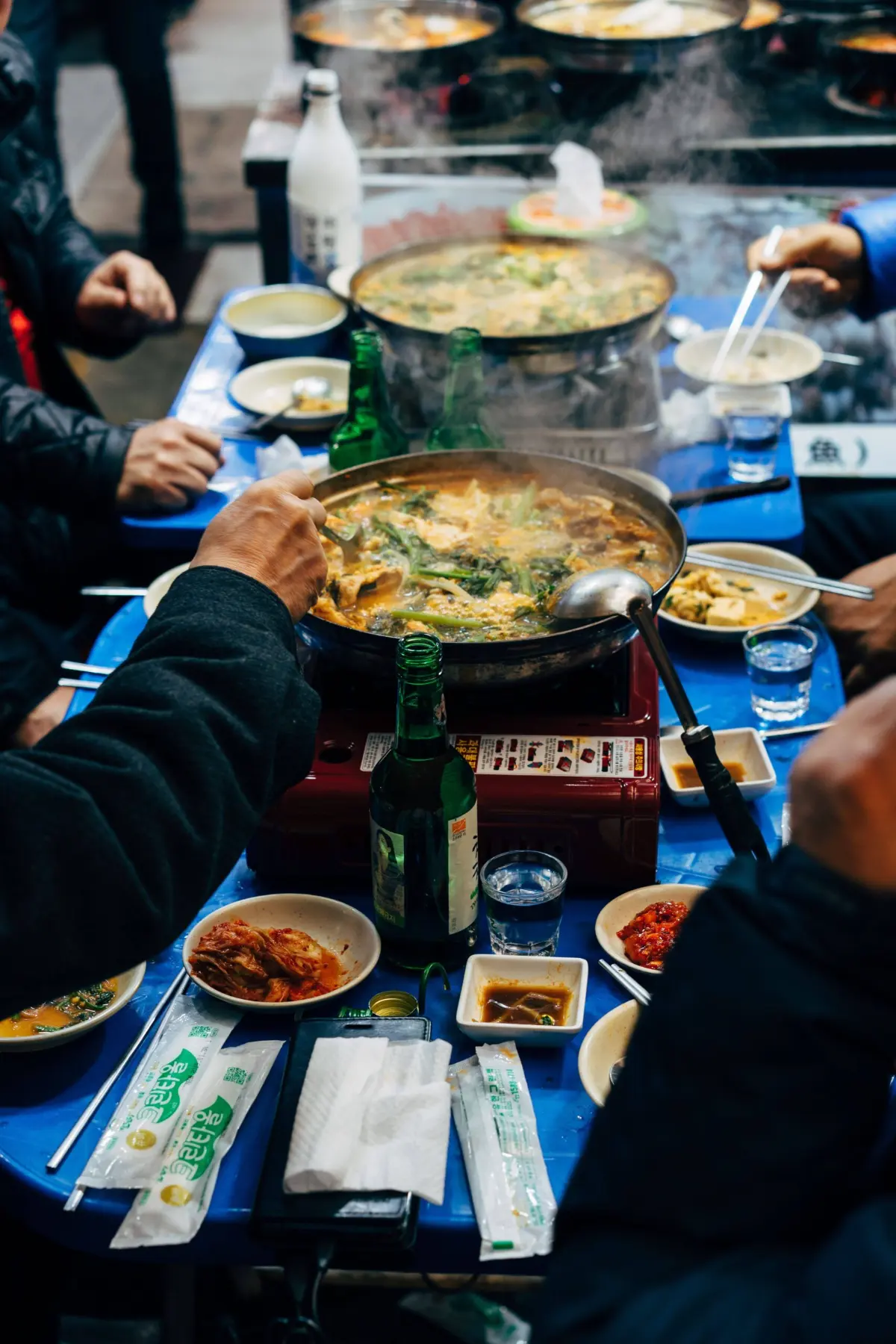
Don’t worry about finding the “most authentic” pocha.
A traditional street tent and a modern indoor pocha are different experiences, but both can tell you something about contemporary Korean nightlife.
What Do You Eat at a Korean Pocha?
This is one of the most important parts of pocha culture.
A pocha isn’t simply a place where people order alcohol.
Food is central to the experience.
And there is no single universal pocha menu.
Menus vary by region, neighborhood and venue type.
A traditional street stall may specialize in a handful of dishes, while a larger indoor pocha can offer dozens.
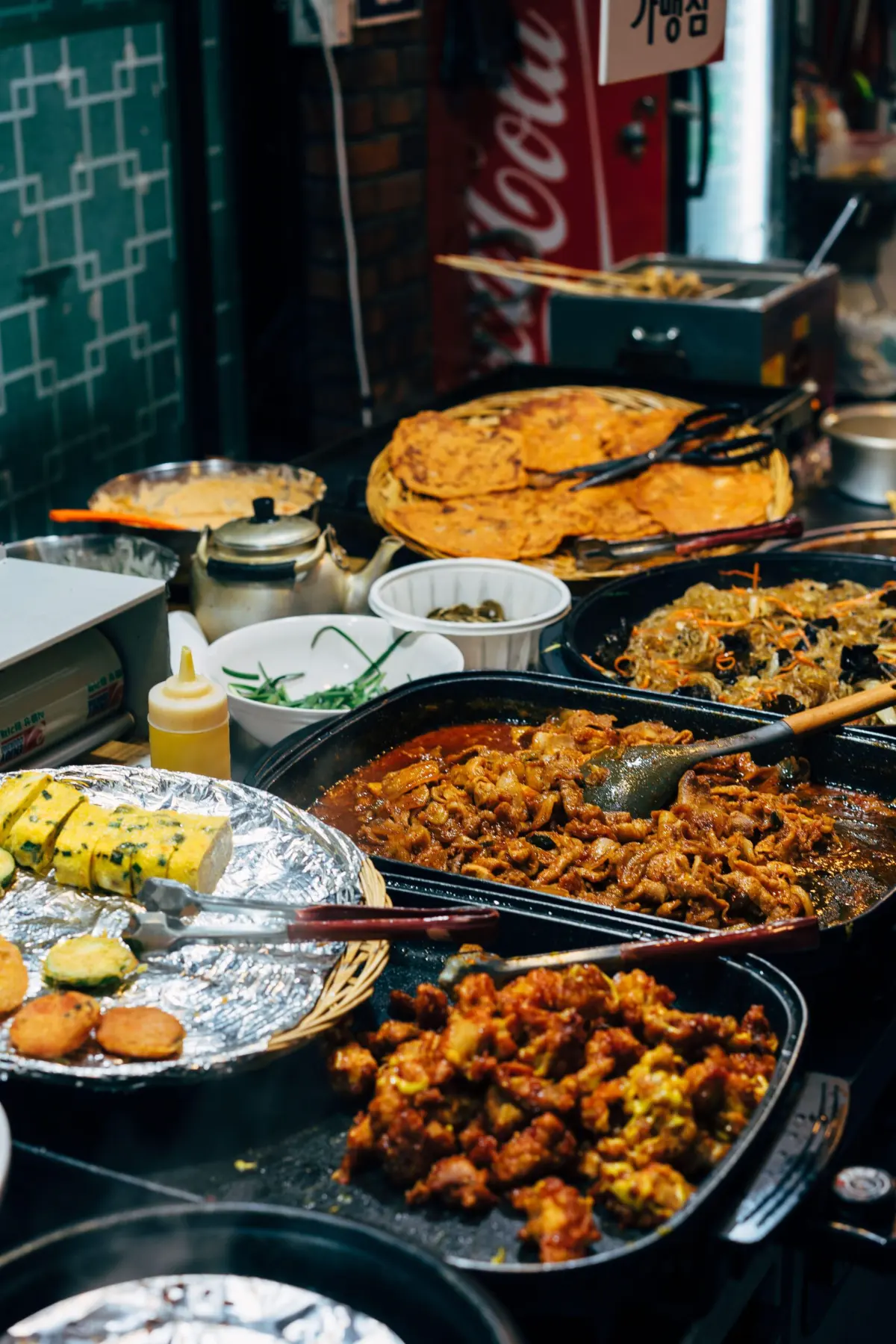
Popular Pocha Foods
Depending on the venue, you may come across dishes such as:
Tteokbokki
Chewy rice cakes in a spicy-sweet red sauce.
One of Korea’s best-known casual foods and a natural fit for informal late-night eating.
Eomuk or Fish Cake Soup
Fish cakes served in hot broth.
Simple, warming and particularly appealing on colder Seoul nights.
Gyeran Mari
A thick Korean rolled omelet.
This is one of the dishes frequently associated with casual drinking food and pojangmacha.
Dakbal
Spicy chicken feet.
They’re not for everyone, but they’re a recognizable example of the stronger-flavored foods often eaten with drinks.
Pajeon and Seafood Pancakes
Savory Korean pancakes are easy to share and pair naturally with drinks.
Udon and Noodles
Hot noodles are another common comfort-food option at street-style venues.
Seafood and Grilled Dishes
Some pochas serve squid, octopus, shellfish or other seafood dishes.
Coastal pojangmacha may focus even more heavily on seafood.
At Jongno 3-ga Pocha Street, official Seoul tourism material specifically highlights foods such as chicken feet, rolled omelet, udon and seafood pancakes alongside soju and beer. The official VISITKOREA listing also mentions snacks including chicken feet, octopus and kimchi pancakes.
Source: Visit Seoul · VISITKOREA
Is Every Pocha Menu the Same?
No.
This is worth repeating because online guides sometimes make pocha sound like a standardized restaurant concept.
It isn’t.
For example, an official VISITKOREA listing for an indoor pojangmacha-style restaurant includes spicy braised chicken, rolled omelet, tteokbokki, mandu soup, beef tartare and sea-snail salad.
Source: VISITKOREA
So don’t arrive expecting every pocha in Korea to serve the same five dishes.
What Do Koreans Drink at a Pocha?
Food may be central, but alcohol is undeniably part of traditional pocha culture.
The two drinks you’ll encounter most often are:
Soju
Soju is one of the drinks most closely associated with Korean nights out.
At a pocha, you’ll often see bottles sitting in the middle of the table and glasses being shared around the group.
If it’s your first time drinking soju in Korea, it’s useful to understand a few basic customs first.
Beer
Beer is another straightforward pocha drink, especially with fried, spicy or salty food.
Depending on the venue, you’ll see Korean domestic beers as well as other options.
Somaek
Soju and beer can also be combined into somaek.
If you’ve seen someone pour soju into a beer glass at a Korean table, there’s a good chance that’s what they’re making.
Official Seoul tourism material on Jongno’s pojangmacha culture specifically describes food accompanied by soju, beer and makgeolli.
Source: Visit Seoul
What Is Anju at a Pocha?
You’ll hear another useful word when learning about Korean drinking culture:
anju (안주).
Anju is food eaten alongside alcohol.
That can include everything from relatively simple snacks to large shared dishes.
At a pocha, many of the foods on the table function as anju.
Think:
Anju deserves its own guide, so we’ll cover it separately rather than turning this pocha article into another 2,000 words about food pairings.
What Is Anju? Korean Drinking Food Explained
Korean Pocha Etiquette for First-Time Visitors
There isn’t a secret list of ten strict rules that applies to every pocha in Korea.
A casual night with friends can be extremely relaxed.
A table involving older coworkers or someone senior may feel more formal.
So rather than inventing special “pocha rules,” use normal Korean dining and drinking etiquette when the situation calls for it.
Share the Food
Many pocha dishes work naturally as shared food.
Instead of assuming everyone should order an individual main course, look at how the group is ordering and follow the table.
Follow Korean Drinking Etiquette in More Formal Situations
If you’re drinking with someone older or senior to you, traditional etiquette can matter more.
Common customs include:
- pouring and receiving drinks with two hands,
- allowing the senior person to drink first,
- and traditionally turning your head slightly away when drinking in front of someone senior.
Visit Seoul’s official etiquette guide describes these customs as part of broader Korean drinking etiquette.
Source: Visit Seoul
Don't Assume Every Table Is Formal
Context matters.
A group of close friends in Hongdae may be far more relaxed than a company dinner involving different ages and ranks.
You don’t need to perform a ceremony every time somebody pours a drink.
Watch the people you’re with and follow their lead.
Check the Menu Before Ordering
Especially at unfamiliar or tourist-heavy venues, look at the menu and prices before ordering.
Don’t assume that “street food” automatically means everything will be extremely cheap.
Don't Treat Drinking as a Competition
Korean drinking culture has plenty of games, toasts and group traditions.
That doesn’t mean you have to match everyone drink for drink.
Drink at your own pace.
And if you’re not drinking alcohol, don’t treat that as something you need to apologize for.
Do You Have to Drink Alcohol at a Pocha?
No universal rule says you must drink alcohol simply because you’re visiting a pocha.
Pocha culture is strongly associated with drinking, and some traditional venues may have a menu heavily focused on alcohol and anju.
But that does not mean every guest is required to drink.
If you don’t drink alcohol:
✓check the menu first,
✓ask what non-alcoholic options are available
✓and focus on the food and social experience.
Modern indoor pochas may have more drink options than a very small traditional street stall.
The exact offering varies from place to place.
Is a Korean Pocha Expensive?
There isn’t one useful answer.
Historically, pojangmacha have been associated with relatively casual and accessible food and drinks.
Jongno’s pocha streets developed as places where ordinary workers could gather over affordable food and alcohol, and official Seoul material still describes that history.
Source: Visit Seoul
But modern pocha prices vary significantly.
A popular area in central Seoul, a trendy indoor pocha and a small local street stall are not necessarily going to charge the same amount.
“pocha = cheap,”
menu prices, portion sizes and whether dishes are intended to be shared.
Where Can You Experience a Pocha in Seoul?
You don’t need to travel across Korea to understand the pocha concept.
Seoul still has places where you can experience classic pojangmacha-style nightlife.
Jongno 3-ga Pojangmacha Street
Jongno 3-ga is one of the best-known examples.
Official VISITKOREA describes the area near Jongno 3-ga Station Exit 6 as a street that becomes lined with temporary food stalls after sundown.
There are both vinyl-covered areas and open tables, and the area is known for snacks including chicken feet, octopus and kimchi pancakes. Operating hours vary by individual stall.
Source: VISITKOREA
Jongno is useful because you’re not visiting an isolated tourist attraction.
You’re seeing pocha culture within a wider Seoul nightlife area.
Why Do Pochas Appear So Often in Korean Dramas?
If you’ve watched enough Korean dramas, you probably already recognize the scene:
someone has had a terrible day.
They sit down under a covered stall.
A bottle of soju arrives.
Then comes the emotional conversation.
That image isn’t accidental.
Pojangmacha have become a recognizable visual shorthand for informal Korean nightlife, food, alcohol and conversation.
Visit Seoul’s official media guide specifically calls out “Pojangmacha in Dramas” and notes that scenes of characters drinking soju at covered food stalls frequently appear in Hallyu dramas.
Source: Visit Seoul
That’s part of why many international visitors already feel that pojangmacha look familiar before they’ve ever sat in one.
But the real version is usually less cinematic.
You may get plastic stools, people talking loudly, steam from cooking food and someone next to you ordering another bottle of soju.
Which, arguably, is better.
Korean Pocha & K-Drama Locations You Can Visit in Seoul
If Korean pocha culture already feels familiar, there is a good reason.
Late-night food, bottles of soju, small tables and emotional conversations are recurring images in Korean dramas. But instead of only watching those scenes on screen, K-drama fans can experience some of that atmosphere in real Seoul.
Here are three places worth adding to your night itinerary.
SEOUL BAM — The Real DANBAM from Itaewon Class
For fans of Itaewon Class, this is the strongest connection between K-drama and Korean pocha culture.
DANBAM is the pub run by Park Sae-ro-yi, played by Park Seo-joon, and one of the central locations in the drama.
VISITKOREA identifies the real filming location as SEOUL BAM.
The location was transformed into DANBAM for filming and became one of the most recognizable places associated with the series.
Best for: Itaewon Class fans, DANBAM photos and a K-drama-themed evening in Itaewon.
Source: VISITKOREA
Noksapyeong Overpass — Iconic Itaewon Class Night View
Not far from the DANBAM area is another location fans will recognize: Noksapyeong Overpass.
The overpass appears repeatedly in Itaewon Class, including scenes involving Park Sae-ro-yi and Jo Yi-seo.
At night, it also gives you a view toward N Seoul Tower and the Seoul skyline, making it an easy stop to combine with DANBAM and an evening in Itaewon.
A simple K-drama route could look like this:
It is not a pocha itself, but it works perfectly as part of a K-drama-inspired Seoul night out.
Jongno 3-ga — Classic K-Drama Pocha Atmosphere
If you care less about standing in one exact filming location and more about experiencing the atmosphere you recognize from Korean dramas, head to Jongno 3-ga.
The area is known for its evening pojangmacha scene, where people gather around small tables for food, beer and soju.
It has many of the visual elements international viewers associate with classic K-drama drinking scenes:
Best for: Traditional pojangmacha atmosphere, Korean street food and a casual Seoul night out.
Source: Visit Seoul
Don’t only chase exact filming locations.
Some of the most memorable experiences in Seoul come from understanding the culture behind the scenes.
A bottle of soju, shared anju, a late-night pocha and friends talking around a small table appear again and again in Korean dramas because they are recognizable parts of Korean social culture.
Filming locations give you the photo.
A real pocha gives you the atmosphere behind it.
Common Pocha Mistakes First-Time Visitors Make
✕Assuming Every Pocha Is a Tent
Traditional pojangmacha are associated with covered street stalls.
Modern pocha can also be completely indoors.
✕Expecting Every Menu to Be the Same
Pocha menus vary enormously.
Don’t build your entire visit around one dish without checking whether the venue actually serves it.
✕Ordering Too Much Immediately
Many dishes are made for sharing.
Start with a reasonable order and add more if you’re still hungry.
✕Assuming Alcohol Is Mandatory
It isn’t a universal requirement.
Check what the venue offers and drink only if you want to.
✕Treating Every Pocha Like a Formal Restaurant
The atmosphere is usually casual and social.
That doesn’t mean ignoring basic manners, but don’t expect fine-dining formality either.
Korean Pocha FAQ
What is a Korean pocha?
A Korean pocha is a casual food-and-drink venue associated with the tradition of pojangmacha, Korea’s covered street stalls.
Today, pocha can refer both to traditional tent-style stalls and modern indoor venues inspired by them.
What does pocha mean?
Pocha (포차) is the shortened form of pojangmacha (포장마차).
In modern Korea, the shortened term is often used more broadly for casual bars and restaurants inspired by traditional pojangmacha culture.
Is pocha the same as pojangmacha?
The terms are closely connected.
Pojangmacha is the full traditional term, while pocha is its common shortened form.
Today, however, “pocha” can also describe indoor venues that are not literal street tents.
What food do you eat at a pocha?
It depends on the venue.
Common examples can include tteokbokki, chicken feet, rolled omelet, noodles, pancakes, seafood and other shared dishes or anju.
There is no universal pocha menu.
What do Koreans drink at a pocha?
Soju and beer are common, while some venues may also serve makgeolli or other drinks.
Soju and beer can also be mixed into somaek.
Do you have to drink alcohol at a pocha?
No.
Pocha culture is strongly connected to alcohol, but drinking isn’t a universal requirement.
Non-alcoholic options depend on the individual venue.
Are Korean pochas tourist-friendly?
Many popular Seoul areas see international visitors, especially places such as Jongno.
However, English menus and English-speaking staff should not be assumed at every traditional stall.
A translation app can be useful.
Where can tourists experience a traditional pocha in Seoul?
One of the most recognizable options is Jongno 3-ga Pojangmacha Street, where temporary food stalls appear after sunset near Jongno 3-ga Station.
Is a pocha the same as a pub?
Not exactly.
A pub is a useful comparison, but pocha culture has its own history, food traditions and relationship with Korean street-stall culture.
Food and shared dishes tend to play a particularly important role.
Want to Experience Korean Drinking Culture in Seoul?
A pocha is one way to experience the food-and-drink side of Korean nightlife.
But if you want to understand another part of what happens around a Korean drinking table, come learn the games too.
Our Korean Drinking Games Night in Hongdae introduces travelers to Korean drinking games, social culture and the traditions that make a Korean night out different.
✓Solo travelers are welcome.
✓Drinking alcohol is optional.
Final Thoughts
A Korean pocha is difficult to explain with a single English word.
It’s part street-food tradition.
Part drinking culture.
Part late-night restaurant.
And part social space.
Traditional pojangmacha helped create the image of people gathering under covered stalls over simple food and soju.
Modern pocha culture has expanded beyond those tents, but the central idea remains familiar:
sit down, order food, share drinks if you want them and spend time together around the table.
If it’s your first visit, don’t worry about performing Korean culture perfectly.
And enjoy one of the most recognizable settings in Korean nightlife.